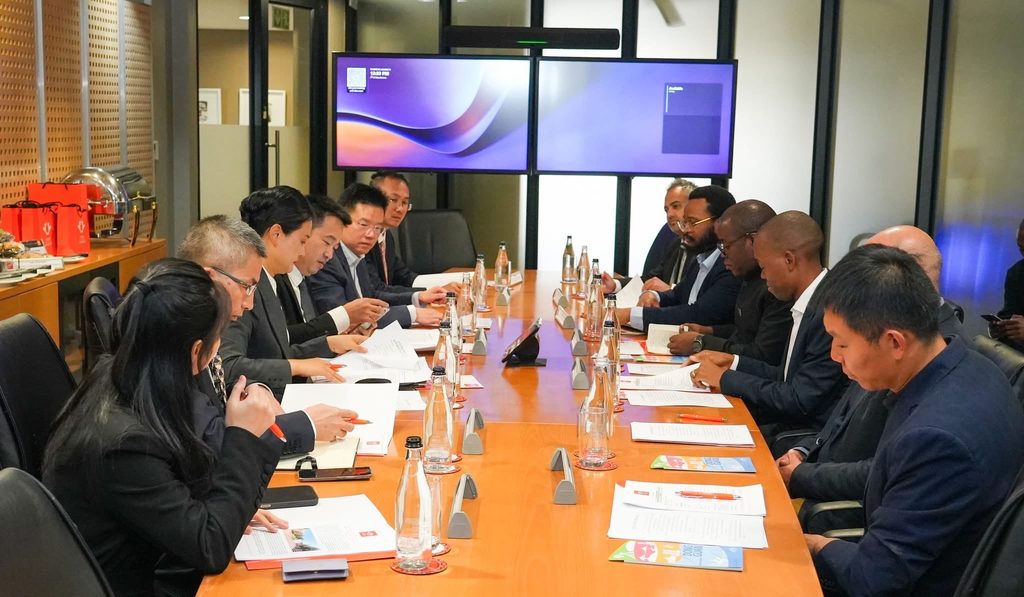
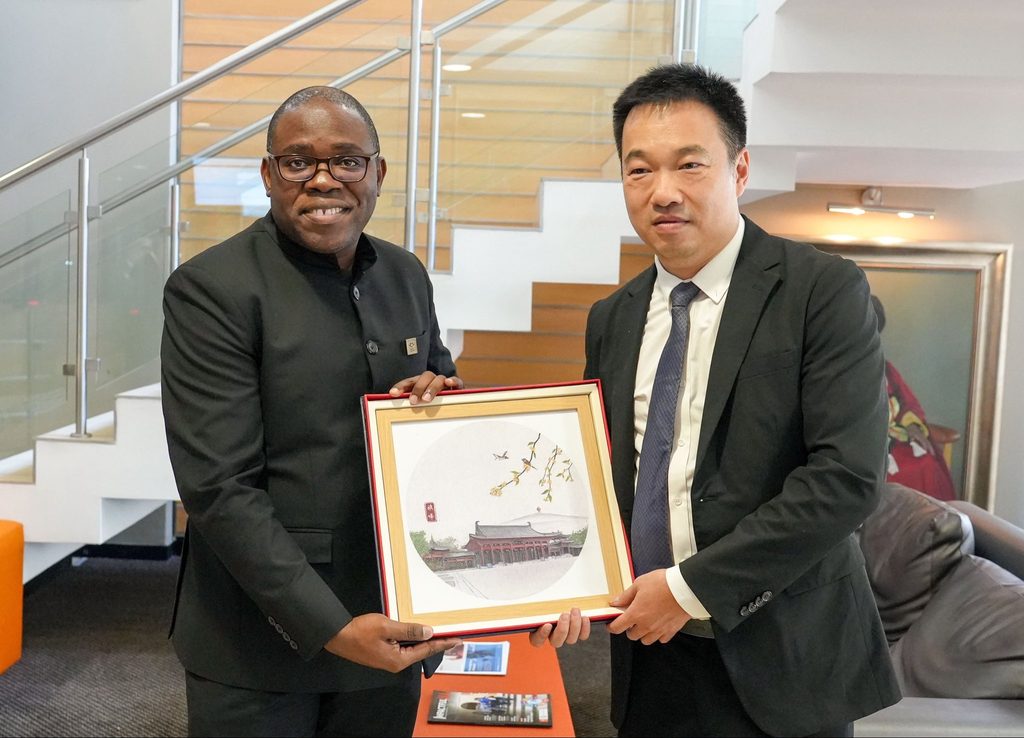
The University of Johannesburg Vice-Chancellor and Principal Professor Letlhokwa Mpedi hosted a senior delegation from Dongguan Municipality in China’s Guangdong Province on 6 August 2026.
The discussions centred on opportunities in business, trade, student mobility, human capacity development, and research commercialisation.
Dongguan, a key city in the Guangdong-Hong Kong-Macao Greater Bay Area with a population of around 10 million, is one of China’s leading manufacturing and high-tech hubs. It is home to hundreds of advanced firms specialising in electronics, artificial intelligence, hardware, and related industries, and is linked to major players including Huawei.
The city has recorded strong foreign trade growth in recent years and produces a significant share of global smartphones and other consumer electronics, while shifting toward higher-value advanced manufacturing and innovation-driven sectors.
The visit forms part of UJ’s broader international engagement strategy under its Strategic Plan 2035, which emphasises global partnerships, societal impact, and technology for the future.
Participants from the university side included leaders from global engagement, the College of Business and Economics, industrial development research, and the Confucius Institute.
For South Africa, closer links with a manufacturing powerhouse like Dongguan hold potential in several areas.
Human capacity development and student mobility programmes could support skills transfer in high-tech fields, helping address domestic needs for technical expertise and innovation capacity.
Research commercialisation collaboration may accelerate the translation of academic work into practical applications, while business and trade discussions could open avenues for investment, joint ventures, and technology partnerships.
These could assist South Africa’s efforts to move beyond raw material exports toward greater industrialisation, beneficiation, and local value addition—priorities repeatedly highlighted in recent bilateral engagements.
The meeting occurs against a backdrop of deepening South Africa-China diplomatic and economic relations.
The two countries, both BRICS members, have advanced cooperation through mechanisms including the China-Africa Economic Partnership Agreement, expanded duty-free market access for African products, ongoing Early Harvest negotiations, and high-level exchanges.
South Africa has reaffirmed its commitment to the One China policy, while both sides emphasise people-to-people ties—2026 having been designated a Year of China-Africa People-to-People Exchanges—as well as practical cooperation in trade, investment, science, and infrastructure.
Educational and research partnerships of this kind complement official diplomacy by building long-term networks in knowledge, technology, and human resources.
Observers note that engagement with specialised manufacturing centres such as Dongguan could help South African institutions and industries access expertise in AI, electronics, and advanced production systems.
If developed into concrete programmes, such collaboration may contribute to skills pipelines, research impact, and economic diversification, reinforcing the strategic partnership between Pretoria and Beijing.