
On the afternoon of November 6, 2026, President Xi Jinping held talks with President Brice Clotaire Oligui Nguema of the Gabonese Republic, who is on a state visit to China, at the Great Hall of the People in Beijing.
The two leaders jointly announced the elevation of bilateral relations to a China-Gabon community with a shared future for the new era.
The discussions focused on expanding trade and investment, strengthening economic cooperation and supporting Gabon’s efforts to diversify its economy beyond raw-material exports. China remains Gabon’s largest trading partner, with bilateral trade reaching approximately $3.94 billion in 2025.
Witnessed by President Xi Jinping and Gabonese President Brice Clotaire Oligui Nguema, Minister of Commerce Wang Wentao and Marie-Édith Tassyla-Ye-Doumbénény, Minister of Foreign Affairs and Cooperation, in charge of Integration and the Diaspora of Gabon, jointly signed the Memorandum of Understanding between the Ministry of Commerce of P.R. China and the Ministry of the Economy, Finance, Debt and Holdings, in Charge of Fighting the High Cost of Living of the Gabonese Republic on Concluding Negotiations on the Early Harvest Arrangement for the Agreement on Economic Partnership for Shared Development between China and Gabon.
Gabon is among the first batch of African countries to sign the Framework Agreements on Economic Partnership for Shared Development with China.
In October 2026, China and Gabon conducted a round of negotiations, reaching agreement on tariff concessions in trade in goods, rules of origin and implementation procedures, and mechanisms, and agreeing to conclude the negotiations on the early harvest arrangement.
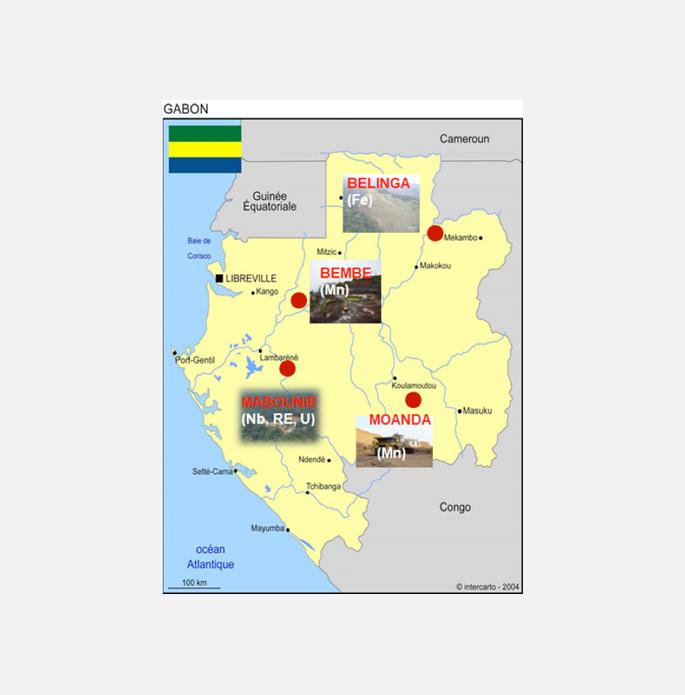
Gabon is hoping to turn its strategic mineral wealth into industrial power by reviving its long-stalled Mabounie niobium and rare-earth project.
A Chinese contractor has reportedly been selected for a major railway and infrastructure programme linked to the Bélinga iron ore deposit. The bigger question is how much lasting value the project will create inside Gabon.
Gabon is moving toward a potentially transformative infrastructure investment associated with its Bélinga iron ore resources.
Reporting published in November indicates that China Harbour Engineering Co. has been selected for a proposed corridor valued at roughly $10 billion, with a railway of approximately 535 kilometres among its central components.
The scale is significant for a country seeking to convert mineral resources into broader economic activity. Large iron ore deposits cannot generate their full commercial value without reliable
transport links, power supply and export facilities.
A dedicated corridor could reduce logistical barriers, connect remote production areas to markets and attract related investment.
Yet a project announcement is not the same as a completed railway. Critical details still include the financing structure, construction timetable, ownership of infrastructure, environmental safeguards and the division of responsibilities between the Gabonese authorities and their partners.
The reported investment figure should therefore be understood as a project value rather than money already spent.
The most important economic test may be whether the corridor serves more than mineral exports.
Local procurement, engineering apprenticeships, maintenance jobs and access for other industries
would help spread benefits beyond the mining sector.
Transparent contracting and public reporting would also allow citizens to assess the project as it develops.
For African policymakers, Gabon’s experience illustrates a recurring dilemma: foreign capital can
help unlock major infrastructure, but the terms of the investment determine whether it supports long-term industrial capability. The country’s challenge is to turn a transport route for ore into an enduring economic asset.