
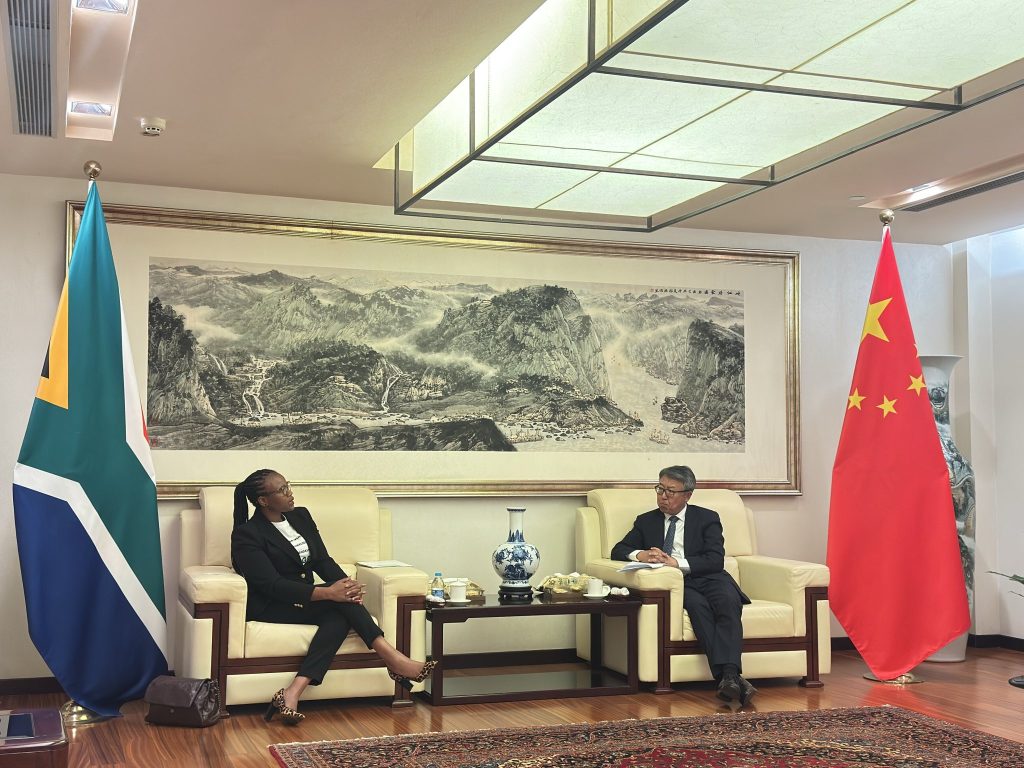
On May 12, 2025, Dr. Nasiphi Moya, the Mayor of Tshwane, hosted a significant meeting with His Excellency Wu Peng, the Chinese Ambassador to South Africa, in a bid to strengthen diplomatic and economic ties.
The gathering, held in a formal setting adorned with South African and Chinese flags, focused on areas of mutual interest: agriculture, vocational training, and the rejuvenation of Pretoria’s inner city.
This meeting comes at a pivotal time for Tshwane, a city grappling with infrastructure challenges, service delivery issues, and the urgent need to revitalize its urban core.
The discussions between Mayor Moya and Ambassador Wu Peng reflect the broader trajectory of China-South Africa relations, which entered a “golden era” following President Xi Jinping’s 2023 state visit.
As highlighted in a speech by Ambassador Chen Xiaodong earlier this year, China aims to deepen cooperation with South Africa through dialogue, exchanges, and tangible projects.
The focus on agriculture and vocational training aligns with China’s strategy of training 10,000 African officials annually, a program that, according to a ScienceDirect study, prioritizes soft power over immediate agricultural impact.
However, for Tshwane, this partnership offers a chance to tap into China’s expertise in urban development and skills training, potentially addressing local challenges like unemployment and food security.
The state of affairs in Tshwane paints a complex picture. The city faces significant service delivery hurdles, as evidenced by public outcry on social media following the meeting. Residents highlighted issues such as a week-long water shortage in Soshanguve, crumbling infrastructure, and the collapse of law enforcement in nearby Johannesburg.
The Rooiwal Wastewater Treatment Plant, which supplies water to Hammanskraal, is overburdened due to population growth and inadequate investment, leading to sewer spillages and inhumane living conditions, as noted in a recent Parliament of South Africa report.
Mayor Moya’s administration is under pressure to deliver, with critics on social media pointing to potholes, lack of streetlights, and rising crime as urgent concerns.
Amid these challenges, the partnership with China offers a glimmer of hope for Pretoria’s inner-city revitalization.
The meeting underscored Tshwane’s commitment to rejuvenating its urban core, a goal already in motion with the West Capital Development Project.
Launched in January 2025, this initiative involves a R1 billion investment to transform the Schubart Park complex into a mixed-use development with 1,300 housing units, retail spaces, and recreational facilities.
The project, a collaboration with the Tsoseletso Consortium, aims to restore dignity to former residents and provide affordable housing, addressing the city’s housing crisis while stimulating economic activity.
A partnership with China could amplify these efforts. China’s expertise in large-scale urban redevelopment, coupled with its vocational training programs, could provide Tshwane with the technical know-how and skilled workforce needed to accelerate inner-city projects.
For instance, training programs could equip local youth with construction and agricultural skills, supporting both the Schubart Park redevelopment and urban farming initiatives to enhance food security.
Moreover, Chinese investment could help modernize Tshwane’s aging infrastructure, tackling issues like water and sanitation while creating jobs.
However, this partnership must be approached with caution.
If executed well, this partnership could mark a turning point for Tshwane, revitalizing Pretoria’s inner city and setting a precedent for international cooperation in addressing urban challenges.